The Importance of Mentorship for Healthy Research Teams in Academic Medicine
Excellence in research is driven not only by scientific rigor, but by the mentorship and collaboration that sustain healthy teams. Healthy research teams do not coincidentally happen. They are built and consistently maintained through intentional structures, shared values, and, perhaps most importantly, effective mentorship.
What Makes a Healthy Research Team?
A “healthy research team” in academic medicine is more than just a collection of people working in the same research lab or group. It is an environment where trainees, staff, and faculty collaborate with trust, respect, and shared responsibility. In these settings, communication is open and transparent, conflicts are addressed constructively, and individuals are supported not only in their technical work but also in their professional growth. Grounded in Saint Louis University’s Jesuit tradition, healthy research teams reflect a commitment to cura personalis, the care of the whole person, by supporting individuals as scholars, professionals, and members of a broader community.
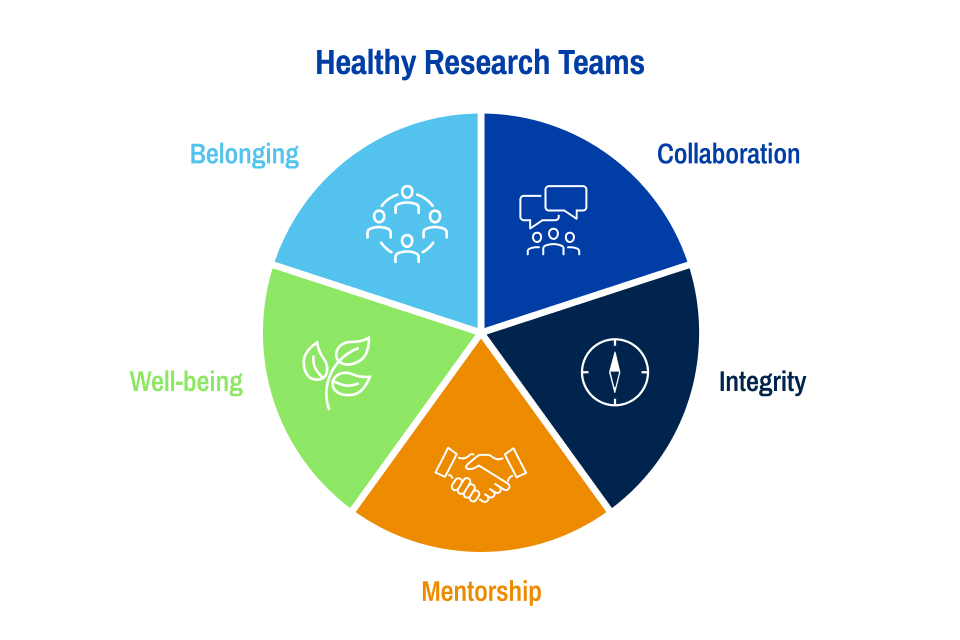
Whether mentoring a clinical research fellow balancing patient care or a graduate student in a basic science lab, healthy research teams prioritize belonging and well-being alongside research productivity. They create a culture of psychological safety where trainees feel safe asking questions, feedback is formative, and workloads and expectations are clearly defined and fair. Importantly, these acknowledge the humanity of each team member, recognizing that success in academic medicine requires not only intellectual rigor but also resilience, adaptability, and care for one another.
Why Mentorship Matters for Healthy Research Teams
Strong mentorship drives healthy research teams forward. Strong mentors do more than teach facts or technical skills; they model professionalism, empathy, and ethical judgment. They help trainees build confidence, navigate setbacks, and develop the independence needed for long-term success.
Evidence shows that effective mentoring is linked to 1) Reduced attrition among trainees; 2) Greater research productivity in labs; including publications and grant success; and 3) Higher satisfaction and reduced burnout for both trainees and faculty. At a broader level, healthier teams can lead to healthier outcomes for learners and institutions. Federal agencies have recognized this connection, and many now require detailed mentoring plans as part of grant proposals, underscoring the national priority placed on mentorship in biomedical research.
Promising Practices for Research Mentors
Building a healthy research team requires more than good intentions. It requires the purposeful use of practical, evidence-based tools. Effective mentors can support clarity, accountability, and trainee development through mentor–mentee agreements. These agreements should articulate expectations and roles for both mentors and mentees. Additional tools include annual individual development plans which help align scholarly training with long-term career goals. Mentoring networks complement these efforts by providing trainees with access to multiple sources of technical, professional, and psychosocial support. Together, these strategies help structure mentoring relationships, normalize ongoing communication, and strengthen the overall research environment.
These formal tools can be more effective when reinforced through everyday practices that shape team culture. Regular one-on-one and group meetings create space to set mutual expectations, foster collaboration, and share successes and challenges. Open conversations about career pathways, both within and beyond academia, help trainees recognize the full range of opportunities their training enables. Integrating well-being into team culture by setting reasonable expectations, normalizing setbacks such as unfunded grants or rejected manuscripts, and highlighting mental health resources supports sustainability and resilience.
Healthy teams also celebrate a broad range of contributions, including teaching, outreach, service, and community engagement, alongside traditional research outputs. Finally, intentional professional development and skill-building, such as leadership training, responsible conduct of research, committee service, and alumni networking, equip trainees with skills essential for long-term success in biomedical careers. By combining these strategies, mentors can create not just productive research groups but thriving communities of scholars where individuals feel supported, valued, and prepared for their future careers.
Preparing for the Future of Academic Medicine
The future of academic medicine depends in part on transferable skills, such as teamwork, leadership, and communication across cultures and disciplines. Strong mentorship can ensure that today’s trainees graduate with these competencies, making them more prepared for diverse career paths and more effective collaborators in complex healthcare and research environments.
By investing in mentorship and fostering healthy research teams now, we can reduce attrition, burnout, and conflict—while cultivating a generation of resilient, ethical, and collaborative researchers. Faculty at the Saint Louis University School of Medicine have an opportunity to reflect on the mentorship they provide and experience within research settings, and to consider how intentional mentoring practices can strengthen our learners and support our academic and research mission.
 Brittany M. Hollister, Ph.D., is the Associate Dean for Graduate Studies and Postdoctoral
Affairs at the Saint Louis University School of Medicine and Assistant Professor of
Family and Community Medicine. Her areas of professional interest include graduate
education policy, mentorship and leadership development, and access to biomedical
research training. Hollister can be contacted via email or on LinkedIn.
Brittany M. Hollister, Ph.D., is the Associate Dean for Graduate Studies and Postdoctoral
Affairs at the Saint Louis University School of Medicine and Assistant Professor of
Family and Community Medicine. Her areas of professional interest include graduate
education policy, mentorship and leadership development, and access to biomedical
research training. Hollister can be contacted via email or on LinkedIn.